UX Case Study · Digital Health · 2026
Guiding patients safely through recovery,
from hospital bed to fully healed.
HealPath is a post-discharge care platform. It links recovering patients, their family caregivers, and their care team through AI-guided daily check-ins, so warning signs get caught early and fewer people end up back in hospital.
My Role
Lead Product Designer
UX · UI · Research
Timeline
12 weeks
Concept → Pilot
Team
1 Designer · 2 Engineers
1 Clinical advisor
Platforms
iOS · Android
Web dashboards
Tools
Figma · Maze
FigJam · Notion
01
Overview
The 30 days after discharge are the most dangerous.
When a patient leaves the hospital after surgery or a cardiac event, the most fragile part of their recovery is only just beginning, at home and largely unsupervised.
Care plans get handed over as paper printouts. Medication schedules turn confusing. The subtle warning signs, like a rising heart rate, a missed dose, or new chest tightness, slip by unnoticed until they turn into an emergency. Families want to help but have no idea what "normal" is supposed to look like, and the care team has no visibility at all between discharge and a follow-up appointment that might be weeks away.
HealPath set out to close that gap with a single connected system: a calm daily companion for the patient, a window of reassurance for the caregiver, and an early-warning radar for the care team.
02
What we were up against
Six challenges surfaced again and again.
Patients can't tell normal from dangerous
Discharge instructions are dense and clinical. Patients don't know which symptoms warrant a call and which are just part of healing.
Medication routines fall apart at home
Multiple new prescriptions, confusing timing, and no reminders mean missed and doubled doses in the first critical weeks.
Caregivers are anxious and in the dark
Adult children are often the primary caregivers. They want daily reassurance but have no real-time view of how their parent is actually doing.
Clinicians fly blind between visits
Doctors get no signal during the highest-risk window and only learn about deterioration when the patient is readmitted.
Existing apps don't fit recovery
Fitness trackers and generic hospital portals aren't built for the specific, time-boxed reality of post-discharge care.
Low digital confidence in older patients
Many patients are 55+ and intimidated by complex apps. Anything we built had to be effortless and forgiving.
03
User Research
Three people, one recovery, each needing something different.
Synthesized from 12 interviews with recently-discharged patients, family caregivers, and clinicians. Three primary personas anchored every design decision.
SP
Dr. Sneha, 41
Doctor · Cardiologist
"By the time I see them at follow-up, the damage is often already done."
Goals
Frustrations
Catch deterioration before readmission
Spend her limited time on the right patients
Trust the data she's acting on
No visibility between discharge and follow-up
Drowning in low-signal alerts elsewhere
Minutes, not hours, per patient
MH
Meena, 32
Caregiver · Daughter
"I check on Dad five times a day and still lie awake worrying."
Goals
Frustrations
Peace of mind that Dad is stable
Know the moment something needs attention
Coordinate with her brother and the doctor
Lives 40 minutes away
Can't interpret vitals on her own
Doesn't want to nag, but feels blind
RK
Ramesh, 58
Patient · Post-cardiac
"I just want to know if what I'm feeling is normal, or if I should be worried."
Goals
Frustrations
Heal and get back to his routine
Not feel like a burden to his children
Take the right meds at the right time
Forgets the evening dose
Anxious about every twinge of chest tightness
The discharge booklet is dense and clinical
1 in 5
cardiac patients are readmitted within 30 days of discharge, many of them preventably.
9 / 12
patients interviewed couldn't confidently name their personal "danger signs."
68%
of caregivers wanted a daily status update they could actually trust.
<3 min
average time a clinician can spend reviewing a patient between visits.
04
Competitor Analysis
Plenty of health apps. None built for the recovery window.
I mapped HealPath against the four alternatives patients actually fall back on. The gap was clear: nothing connected all three people around the post-discharge moment.
Capability
Hospital portal
Fitness / wearable app
Telehealth app
Phone follow-up
Built for post-discharge recovery
✓
~
✕
✕
~
AI symptom triage & daily check-in
✓
✕
✕
~
✕
Caregiver / family access
✓
✕
~
✕
~
Live wearable vitals
✓
✕
✓
✕
Doctor early-warning dashboard
✓
~
✕
✕
✕
One-tap emergency (SOS)
✓
✕
~
✕
✕
Designed for low digital literacy
✓
✕
✕
~
✓
✓
Full support
~
Partial
✕
None
HealPath
05
The Process
A focused, double-diamond sprint.
01
Discover
12 interviews, a literature scan on readmissions, and shadowing a discharge nurse.
02
Define
Personas, journey maps, and the core "act before emergency" problem statement.
03
Ideate
Crazy-8s, IA exploration, and paper wireframes for all three user types.
04
Design
High-fidelity flows, a shared design system, and connected prototypes.
05
Validate
Usability tests with 6 users + an 8-week simulated care pilot.
06
Paper Wireframes
Sketching the patient journey before pixels.
Low-fi sketches let me test the daily check-in idea fast, and kill the cluttered first attempts before they cost anything.
Patient app, first pass
↳
Tested with 3 patients. The one-question-per-screen check-in beat the long form every single time.
7-day trend chart
Vitals
red SOS lives here + on every screen
08
User & Task Flows
How each person moves through their day.
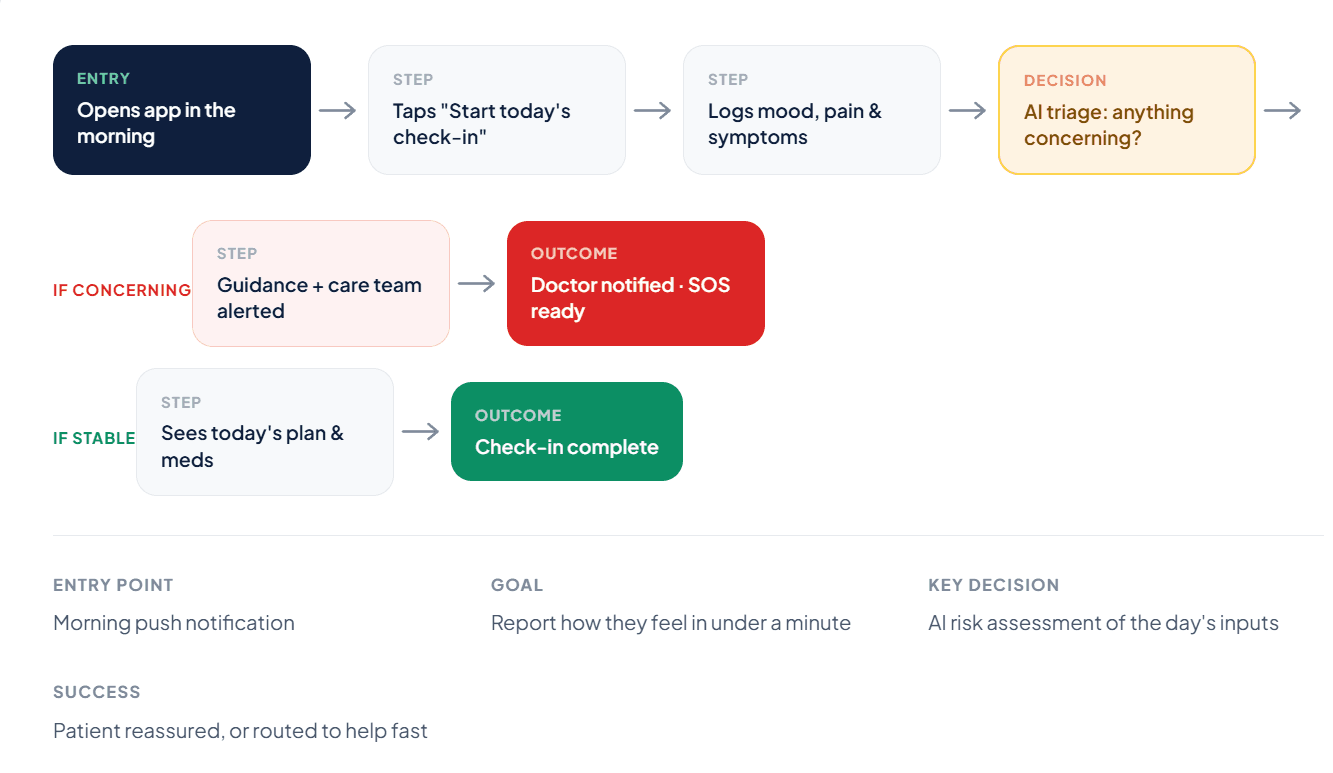
The same risk signal drives three connected flows. The patient logs it, the caregiver gets looped in, and the doctor decides what happens next. Switch between them:
Patient · daily check-in
Patient · daily check-in
Patient · daily check-in
Caregiver · oversight
Doctor · triage
09
The Solution
A calm companion, a window of reassurance, an early-warning radar.
Patient · 01
A daily check-in that actually gets done
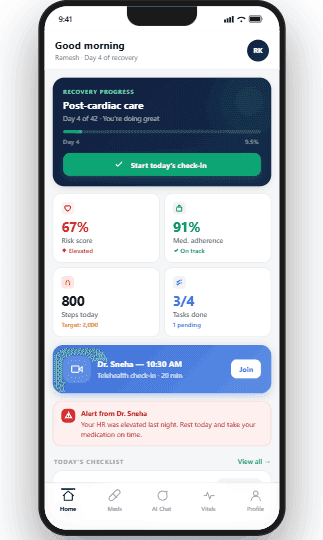
The home screen leads with one warm, oversized action: today's check-in. Asking one question at a time (mood, then pain, then symptoms) keeps it effortless for a 58-year-old recovering at home, and it feeds the AI that decides whether to reassure or escalate.
Patient · 02
Medication & vitals, made effortless
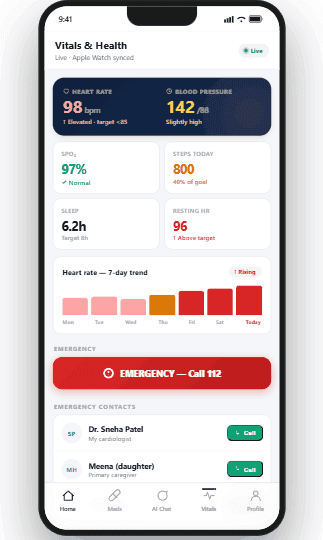
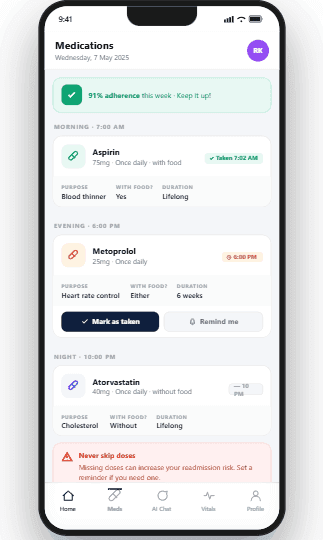
Big, forgiving tap targets turn medication tracking into a single tick. Wearable vitals stream in on their own and get translated into plain language like "slightly high" or "above target," with a red SOS never more than a tap away.
Caregiver · 03
Caregivers, finally in the loop
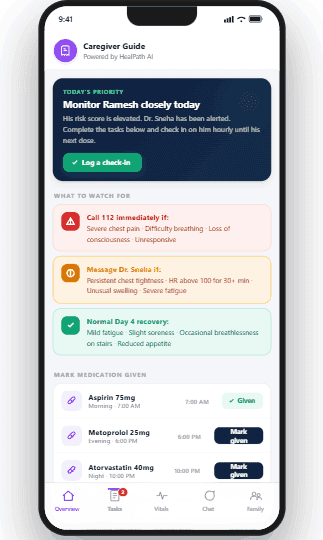
Meena opens the app and instantly knows where things stand: a risk score, the latest vitals, and exactly what needs her attention today. Urgent alerts always come with a clear next step, whether that's checking on her dad or calling the doctor, so worry turns into something she can actually act on.
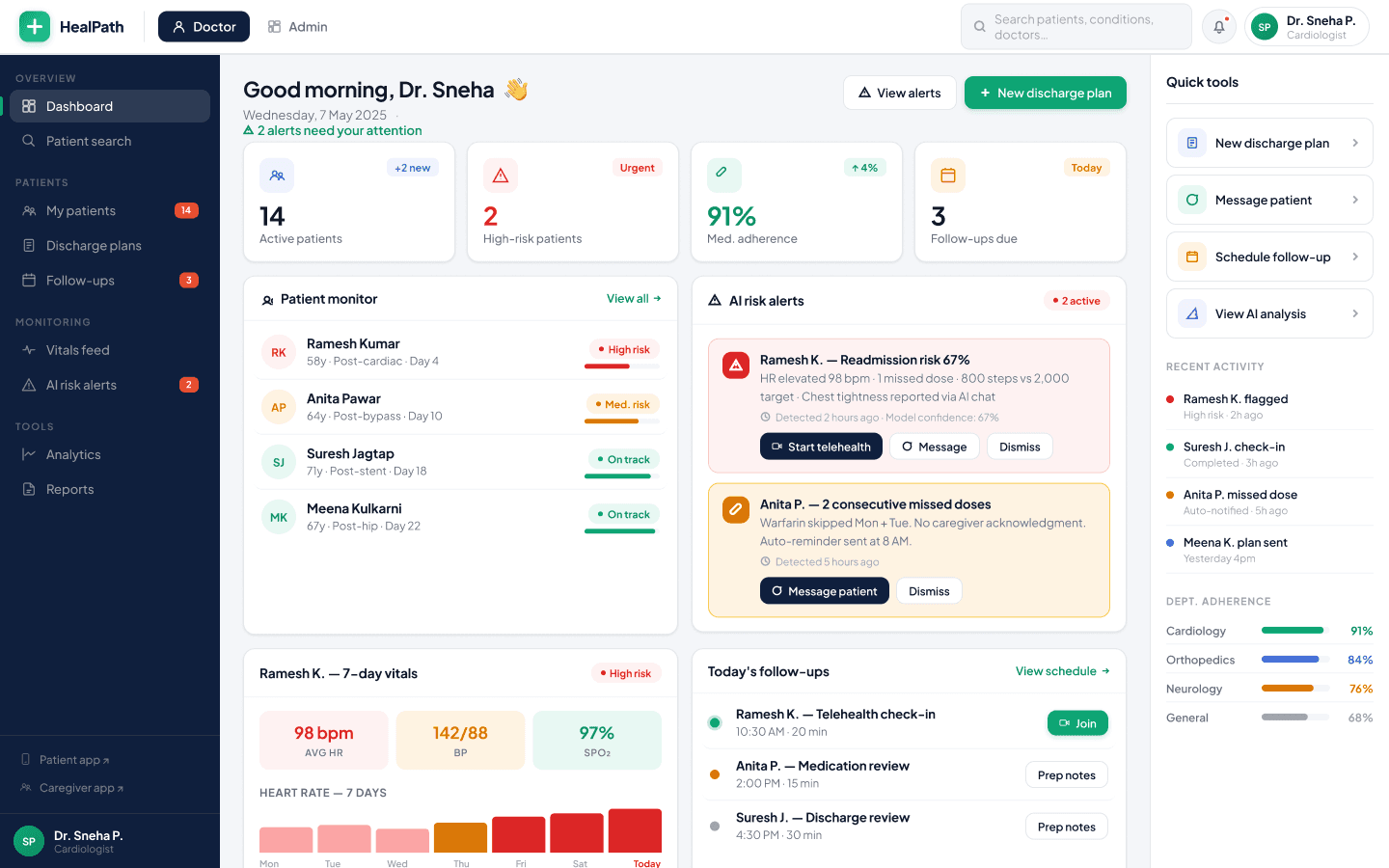
Doctor dashboard · 04
An early-warning radar for the doctor
Dr. Sneha's dashboard ranks her caseload by risk and surfaces AI-flagged deterioration the moment it shows up. It turns "I'll find out at the follow-up" into "I can act today," with discharge plans, messaging and follow-ups all one click away.
app.healpath.care/doctor
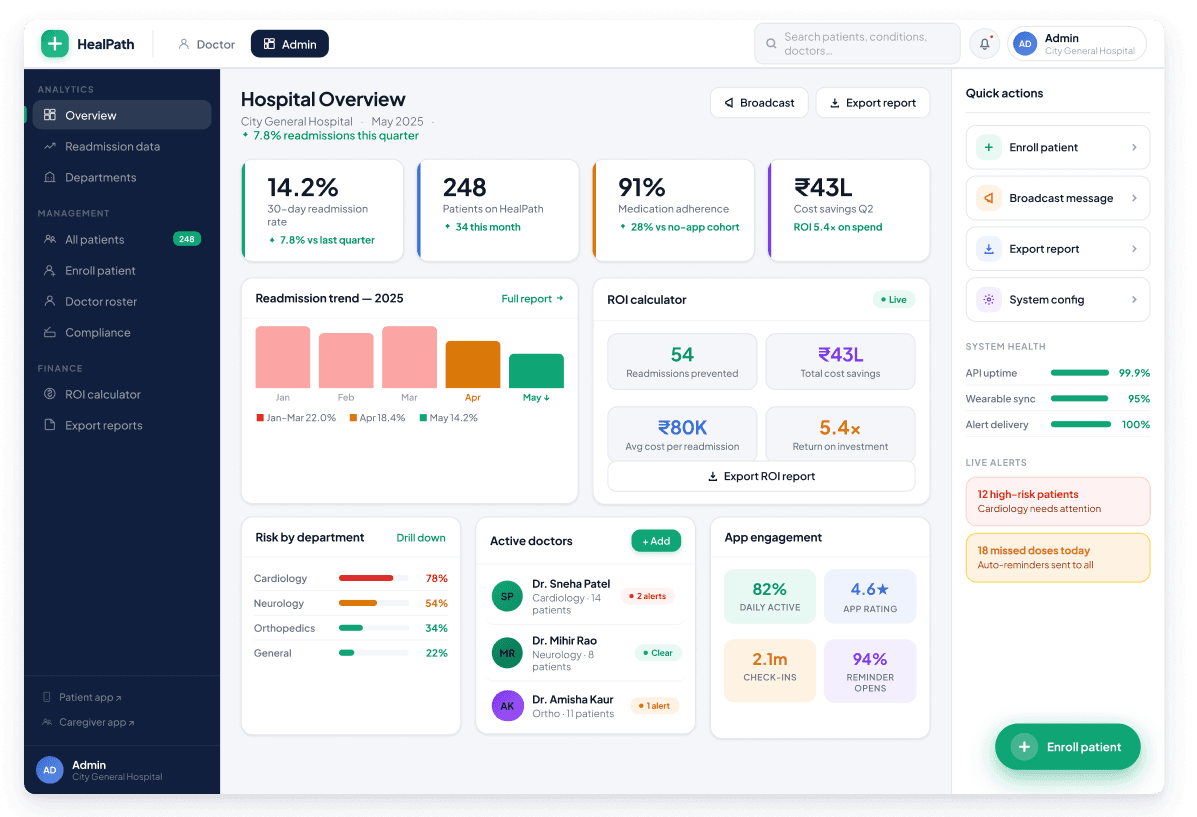
Admin dashboard · 05
The whole hospital, at a glance
Hospital admins get the bird's-eye view: readmission trends, medication adherence across the cohort, department-level risk, and a live ROI calculator. This is the layer that proves the programme is working and shows leadership exactly where to focus next.
app.healpath.care/admin
10
Reflection
What I'd carry forward.
What worked
Designing every surface around a single shared signal kept the product coherent across all four roles. The one-question check-in turned out to be the real unlock, because simplicity is what drove adherence.
What I'd change
I over-built the doctor dashboard early on. The real impact came from the alert ranking, not the breadth of analytics, so next time I'd cut straight to that core sooner.
What's next
Pharmacy and EHR integration, multilingual check-ins for wider access, and a real-world clinical pilot to validate the readmission numbers.

app.healpath.care/doctor
The Problem
How might we help recovering patients follow their care plan at home, while giving caregivers and doctors enough visibility to
act before a small issue becomes an emergency?
v0 · pen & paper
recovery progress
Home
big "start check-in" CTA up top ✓
pain scale 0–10
Check-in
mood → pain → symptoms, one Q per screen
Meds
tick = taken. keep it huge & tappable
07
Information Architecture
One platform, four tailored surfaces.
Each role sees only what's relevant to them, and they all draw from the same shared record of the patient's recovery.
HealPath Platform
Thanks for reading.
HealPath · UX Case Study · Patient · Caregiver · Doctor · Admin
Patient App
Home & recovery progress
Daily AI check-in
AI chat & triage
Profile · SOS · Contacts
iOS · Android
Medications
Vitals & trends
Caregiver App
Patient overview & risk
Care tasks
Messages with care team
iOS · Android
Patient vitals
Care circle & access
Doctor Dashboard
Patient roster
AI risk alerts
Discharge plans
Web
Vitals feed
Follow-ups & reports
Admin Dashboard
Hospital overview & KPIs
Readmission analytics
ROI calculator
Web
Patients & doctor roster
Compliance & reports
Recovery progress front and centre: "Day 4 of 42"
AI triage routes risk to the care team automatically
Glanceable vitals, adherence and task cards
One-tap "mark as taken" with smart reminders
Live heart rate, BP and SpO₂ from the wearable
7-day trends that flag what's drifting
At-a-glance risk score and live vitals
Assigned care tasks with gentle reminders
One tap to the doctor or emergency services

Outcomes
The right people, informed at the right moment.
Directional results from an 8-week simulated pilot with 12 participants and 6 moderated usability sessions. They're indicative of impact, not clinical claims.
32
%
projected drop in 30-day readmissions vs. baseline
91
%
medication adherence, up from a 64% baseline
4.7
/5
patient satisfaction. "I always knew where I stood"
2
×
faster clinical response to early deterioration